How to Improve Your HRV with Breathing: A Practical Guide
If you wear an Oura Ring, Apple Watch, or Whoop, you've seen a number called HRV. It shows up in your readiness score, your recovery metrics, and your sleep analysis. When it's high, the app tells you you're recovered. When it's low, it tells you to take it easy.
But most people treat HRV as read-only. Something that happens to them. Good sleep, high HRV. Bad day, low HRV.
It doesn't have to be passive. HRV is trainable. And the most effective training method is also the simplest: controlled slow breathing.
What HRV Actually Measures
Your heart doesn't beat like a metronome. Even at a steady 60 bpm, the intervals between beats constantly fluctuate: 0.9 seconds, then 1.1, then 0.95, then 1.05.
Heart rate variability is the measurement of those fluctuations. And counterintuitively, more variation is healthier.
High HRV means your autonomic nervous system is responsive. It can shift quickly between sympathetic activation ("go" mode) and parasympathetic recovery ("rest" mode) depending on what you need. Low HRV means the system is rigid, often stuck in a stress-dominant state.
The Metrics Your Wearable Reports
| Metric | What It Measures | Used By |
|---|---|---|
| RMSSD | Beat-to-beat variability (parasympathetic activity) | Oura, Whoop |
| SDNN | Overall variability (total autonomic activity) | Apple Watch |
| HF Power | High-frequency component (vagal tone) | Clinical devices |
| LF Power | Low-frequency component (baroreflex + mixed) | Clinical devices |
RMSSD is the gold standard for daily tracking. It directly reflects vagus nerve activity, which controls recovery, digestion, and emotional regulation. If your wearable reports one number as "HRV," it's almost certainly RMSSD.
Important: RMSSD and SDNN are measured in different ways, so you can't directly compare an Oura number (RMSSD) with an Apple Watch number (SDNN). Pick one device and track your trend against your own baseline.
Why HRV Predicts Your Health
HRV isn't just a recovery metric. It's one of the strongest non-invasive predictors of overall health and longevity.
Mortality Risk
A meta-analysis of 32 studies with 38,008 participants (Jarczok et al., 2022) found that lower HRV predicts higher mortality regardless of age, sex, or population type. The relationship is dose-dependent:
- Each 10 ms increase in SDNN confers a 20% decrease in mortality risk
- SDNN below 50 ms: classified as "unhealthy"
- SDNN 50-100 ms: "compromised"
- SDNN above 100 ms: "healthy"
A separate study of centenarians found those with higher HRV survived an additional 1.6 years on average, and the lower-HRV group had a 5x increased risk of mortality (Zulfiqar et al., 2010).
Stress Resilience
Higher resting HRV is consistently associated with better emotion regulation, cognitive flexibility, and faster recovery from stressors. Stephen Porges' Polyvagal Theory explains why: the vagus nerve is central to how we regulate our responses to the environment, and HRV reflects vagal tone in real time.
People with higher baseline HRV don't just recover faster from stress. They respond to it differently. Their nervous system has more range.
Athletic Recovery
Athletes and coaches use HRV to guide training decisions. A suppressed HRV after a rest day signals incomplete recovery and increased injury risk. An elevated HRV signals readiness for harder training. HRV-guided training programs have been shown to improve performance outcomes compared to fixed training plans.
Mental Health
Lower HRV is consistently associated with depression, anxiety, and PTSD. A meta-analysis of 14 RCTs found a medium effect size (g = 0.38) for HRV biofeedback on depressive symptoms (Pizzoli et al., 2021). For anxiety, a separate meta-analysis found effect sizes of 0.81 (Goessl et al., 2017), which is large by clinical standards.
Age-Related Decline
HRV naturally declines with age. But this decline isn't fixed. Regular breathing practice can slow, halt, or partially reverse it. The training effect applies at any age.
How Breathing Trains HRV
Every inhale slightly activates your sympathetic nervous system (heart rate rises). Every exhale activates the parasympathetic system via the vagus nerve (heart rate drops). This natural oscillation is called respiratory sinus arrhythmia (RSA).
When you breathe slowly and deliberately, you amplify RSA. Each breath cycle gives the vagus nerve a longer, stronger activation. Over time, this strengthens vagal tone, similar to how repeated exercise strengthens a muscle.
The key finding: this isn't just an acute effect. A 2022 meta-analysis of 223 studies (Laborde et al., Neuroscience & Biobehavioral Reviews) confirmed that slow breathing increases vagally-mediated HRV in three timeframes:
- During the breathing session (immediate)
- Immediately after a single session (acute aftereffect)
- After weeks of regular practice (chronic improvement)
The chronic improvement is the important part. You're not just calming yourself in the moment. You're remodeling your autonomic nervous system's baseline.
Why Resonance Frequency Matters
Not all slow breathing rates produce equal HRV gains. Your cardiovascular system has a natural resonance frequency (typically around 5.5 breaths per minute) where heart rate oscillations are maximized. Breathing at that exact rate produces significantly larger HRV improvements than breathing at even slightly different rates.
The Steffen et al. (2017) study tested this directly: participants breathing at their exact resonance frequency showed better outcomes than those breathing just 1 bpm faster. Even small deviations reduce the training effect.
For the full science behind resonance frequency, including the fascinating connection to ancient prayer traditions, see The Science Behind Resonance Breathing at 5.5 Breaths Per Minute.
How Quickly HRV Improves
The research shows a dose-dependent timeline:
| Timeframe | What the Research Shows |
|---|---|
| Single session | HRV increases during even 5-minute sessions. Immediate calming effect. |
| 1 week | Note your baseline. Most people report the practice feeling more natural by mid-week. |
| 4 weeks (daily) | Measurable increase in resting HRV. Improved cognition and reduced perceived stress (Chaitanya et al., 2022, RCT). |
| 5 weeks | Significant improvements in emotion regulation. Blood pressure reductions in prehypertensive participants. |
| 10 weeks | Cumulative increases in total HRV across all frequency bands. Mood improvements across tension, anger, depression, and fatigue (Lagos protocol). |
| After stopping | Training effects persisted 12 weeks after practice cessation (Gross et al., 2018). |
The minimum effective dose is lower than you'd expect. Even twice-daily 5-minute sessions produced meaningful benefits. A systematic review found that home practice was more effective than lab-based sessions, and less than 20 minutes per day outperformed longer durations (Lehrer et al., 2020).
Measuring HRV: Oura, Apple Watch, and Whoop
Oura Ring
Oura measures RMSSD averaged across the entire night of sleep. This is the most relevant metric for tracking breathing practice effects, because overnight HRV reflects your autonomic baseline without the noise of daytime activity.
What the research says: Oura demonstrates 99.3% accuracy for resting heart rate and 91.5% accuracy for RMSSD, underestimating by about 10.2 ms compared to clinical ECG (Miller et al., 2022). The finger placement provides cleaner photoplethysmography (PPG) signals than wrist devices, because fingers have richer vasculature.
How to read your Oura HRV trend:
- Look at the 7-day and 30-day trend, not individual nights. A single bad night (alcohol, late meal, poor sleep) will tank your HRV temporarily. That's noise, not signal.
- Your baseline is what matters. After 2-4 weeks of consistent breathing practice, you should see the trendline shift upward.
- Oura's "Optimal" HRV range is personalized to you. The goal isn't to hit someone else's number. It's to move your own baseline higher.
- Time of night matters. Oura averages the full night, which includes lighter sleep phases where HRV is naturally lower. This is why Oura often reports lower numbers than Whoop.
Apple Watch
Apple Watch measures SDNN, sampled at various points during the day and sleep. It underestimates HRV by about 9.6 ms on average.
The main limitation: Apple samples at inconsistent times each day, which makes day-to-day comparison less reliable. It's useful as a general indicator, and third-party apps can access HRV data through HealthKit for better analysis.
Important: Because Apple Watch reports SDNN and Oura reports RMSSD, their numbers are not directly comparable. Don't switch between devices and expect a meaningful trend.
Whoop
Whoop measures RMSSD during the last period of slow-wave (deep) sleep. It's the most accurate consumer wearable for HRV, with 99% accuracy and the smallest measurement error (SD = 3.9 ms vs. 28-47 ms for others).
Because Whoop samples during deep sleep specifically (rather than averaging the full night), it almost always reports higher HRV values than Oura for the same person on the same night. This isn't an error. It's a different measurement window.
Which Device to Use
For tracking the effects of breathing practice on HRV:
- Pick one device and stick with it. Consistency matters more than accuracy.
- Oura or Whoop are better than Apple Watch for this purpose, because RMSSD is more responsive to vagal tone changes than SDNN, and overnight measurement eliminates daytime variability.
- Track trends over weeks, not days. HRV fluctuates daily based on sleep, alcohol, illness, stress, and dozens of other factors.
A 4-Week HRV Training Protocol
The technique: Resonant Breathing. 5.5 seconds in, 5.5 seconds out. No breath holds. Smooth and continuous through the nose.
Week 1: Build the habit
- 5 minutes per day, once daily
- Morning or evening, whichever is easiest to keep consistent
- Focus on making the rhythm feel natural, not forced
- Note your Oura baseline HRV average for this week
Week 2: Extend duration
- 10 minutes per day
- If 5.5 seconds per phase feels strained, try 5.0 seconds. If it feels easy, try 6.0
- You should notice the session feeling calmer and more automatic by mid-week
Week 3: Optimize timing
- 10-15 minutes per day
- Experiment with timing: some people see bigger sleep HRV improvements from evening sessions, others from morning
- Compare your Oura weekly average to Week 1
Week 4: Lock in
- 15 minutes per day (or two 7-minute sessions)
- By now the breathing rhythm should feel automatic
- Compare your 7-day Oura HRV average to your Week 1 baseline
- Research predicts a measurable increase if you've been consistent
After Week 4: Maintain with 10-15 minutes daily. The Chaitanya et al. study showed significant improvements at this point, and the Gross et al. study showed effects persisted 12 weeks after stopping. But consistent practice produces the best long-term results.
What Affects Your HRV (Besides Breathing)
Your daily HRV is influenced by many factors. When interpreting your Oura data, account for these:
| Factor | Effect on HRV |
|---|---|
| Alcohol | Suppresses HRV dramatically, even 1-2 drinks |
| Poor sleep | Lower HRV, especially with reduced deep sleep |
| Overtraining | Suppressed HRV for 24-48 hours |
| Illness | Drops before symptoms appear (Oura detected COVID onset in studies) |
| Chronic stress | Gradually lowers baseline |
| Exercise | Acute drop, then rebound above baseline if recovered |
| Caffeine | Mild suppression, varies by individual |
| Late meals | Digestion during sleep lowers HRV |
This is why weekly trends matter more than daily readings. One low night doesn't mean your training isn't working.
Build Your HRV Practice with Pust Focus
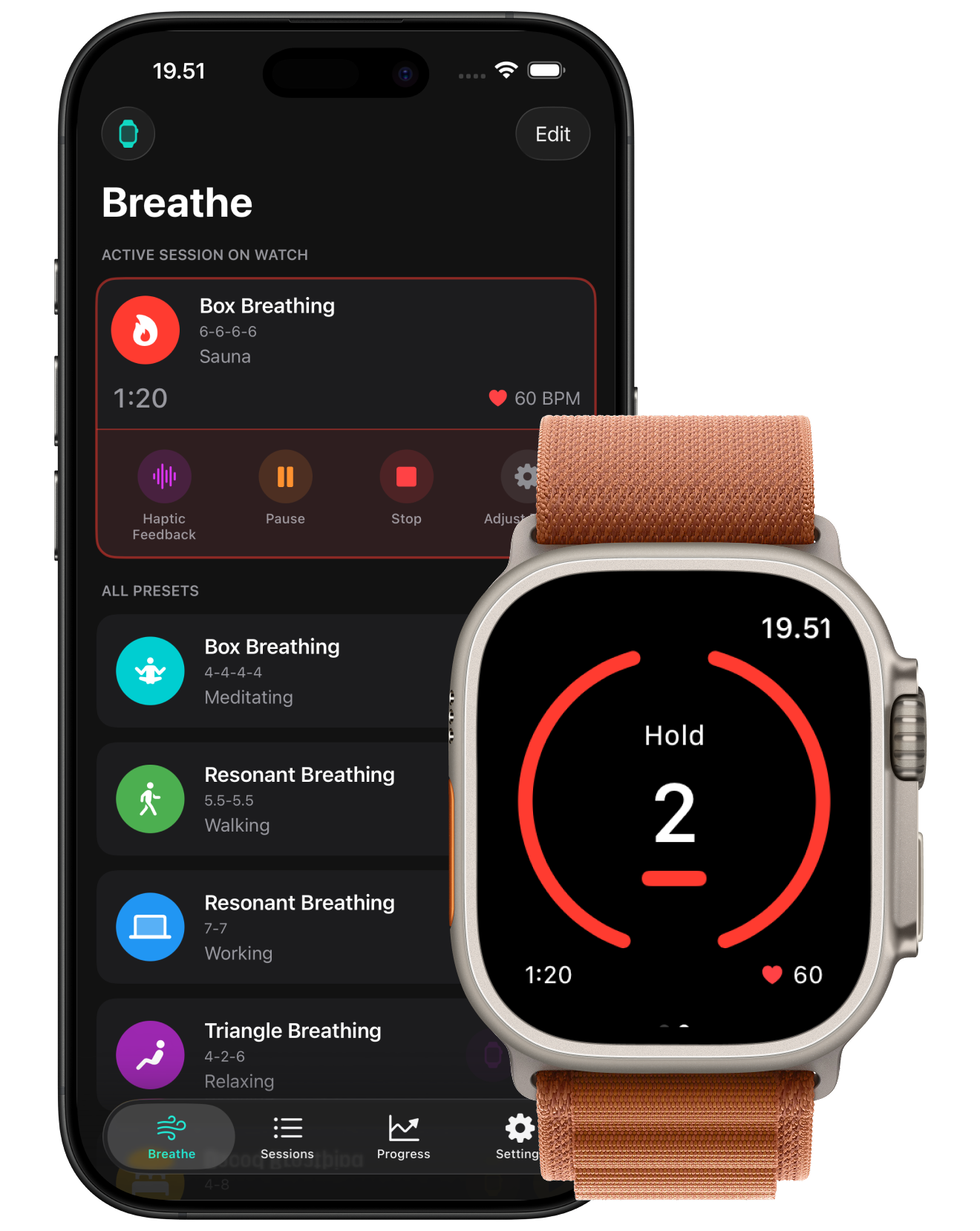
I built Pust Focus so you can do your daily HRV training without stopping to stare at a screen. Resonant Breathing is free, set to 5.5-5.5 by default. Haptic pulses guide each phase on your Apple Watch, so you practice during your day.
With premium ($4.99 once, no subscription), you can adjust the timing to find your personal resonance frequency, which matters for maximizing HRV gains. Sessions save to Apple Health with heart rate data, so you can correlate your practice with your Oura or Apple Watch HRV trends over time.
The workflow I use: practice on my Watch or iPhone, track results on my Oura Ring.
References:
- Jarczok, M.N., et al. (2022). Heart rate variability in the prediction of mortality. Neuroscience & Biobehavioral Reviews. PubMed
- Zulfiqar, U., et al. (2010). Heart Rate Variability and Exceptional Longevity. Frontiers in Physiology. PMC
- Laborde, S., et al. (2022). Effects of voluntary slow breathing on heart rate and heart rate variability. Neuroscience & Biobehavioral Reviews. PubMed
- Steffen, P.R., et al. (2017). Impact of Resonance Frequency Breathing on HRV, Blood Pressure, and Mood. Frontiers in Public Health. PMC
- Chaitanya, S., et al. (2022). Effect of Resonance Breathing on Heart Rate Variability and Cognitive Functions in Young Adults. Cureus. PMC
- Lehrer, P., et al. (2020). Heart Rate Variability Biofeedback Improves Emotional and Physical Health and Performance. Applied Psychophysiology and Biofeedback. PubMed
- Gross, M.J., et al. (2018). Effects of heart rate variability biofeedback training in athletes. PLOS One. Link
- Pizzoli, S.F.M., et al. (2021). A meta-analysis on heart rate variability biofeedback and depressive symptoms. Scientific Reports. Link
- Goessl, V.C., et al. (2017). The effect of heart rate variability biofeedback training on stress and anxiety. Psychological Medicine. PubMed
- Porges, S.W. (2007). The Polyvagal Perspective. Biological Psychology. PMC
- Miller, D.J., et al. (2022). A Validation of Six Wearable Devices for Estimating Sleep, Heart Rate and Heart Rate Variability in Healthy Adults. Sensors. PMC
- Shaffer, F., & Ginsberg, J.P. (2017). Overview of Heart Rate Variability Metrics and Norms. Frontiers in Public Health. PMC
Try Pust Focus
Breathwork that fits your day, on iPhone and Apple Watch. Free to try, $4.99 once for everything.