The Science Behind Resonance Breathing at 5.5 Breaths Per Minute
There's a specific breathing rate at which your heart, lungs, and circulatory system synchronize. Your heart rate variability peaks. Your blood pressure oscillations align with your respiratory rhythm. Your baroreflex operates at maximum efficiency.
That rate is approximately 5.5 breaths per minute. And it shows up everywhere, from laboratory studies to ancient prayer traditions.
The Resonance Frequency
Your cardiovascular system is an oscillating system. Like a pendulum or a tuning fork, it has a natural frequency at which it resonates most strongly. For most adults, this falls between 4.5 and 7.0 breaths per minute, with 5.5 being the most common.
This idea was formalized by researchers Evgeny Vaschillo and Paul Lehrer at Rutgers University. After meeting in St. Petersburg in 1992, they spent decades studying how breathing at specific rates affects the cardiovascular system. Their work established the field of heart rate variability (HRV) biofeedback.
The protocol is straightforward: breathe at different rates (6.5 down to 4.5 breaths per minute, in 0.5 bpm steps) while monitoring heart rate oscillations. The rate that produces the largest heart rate swings is your personal resonance frequency.
For most people, that's right around 5.5 bpm, which translates to a 5.5-second inhale followed by a 5.5-second exhale.
What Happens at Resonance
At 5.5 breaths per minute (approximately 0.1 Hz), three oscillatory systems lock into phase:
1. Respiratory rhythm (your breathing)
2. Mayer waves (natural blood pressure oscillations at ~0.1 Hz)
3. Heart rate oscillation (respiratory sinus arrhythmia)
When these three systems synchronize, researchers call it coherence. And coherence isn't just a nice concept. It has measurable physiological consequences.
A Note on Names
You'll see this practice called different things: Coherent Breathing (a term coined by Stephen Elliott in 2005), Resonance Frequency Breathing, or HRV Biofeedback Breathing. They all refer to the same core practice: breathing at your cardiovascular resonance frequency (typically 5.5 bpm) to maximize heart rate variability and autonomic balance. Elliott's work built on the Lehrer/Vaschillo research and brought it to a wider audience.
In this post, we'll use "resonance breathing" and "resonant breathing" interchangeably.
Maximum HRV
A study by Steffen et al. (2017, Frontiers in Public Health) at Brigham Young University compared three groups: one breathing at their determined resonance frequency, one breathing slightly faster, and a control group sitting quietly.
Results:
- The resonance frequency group reported higher positive mood
- They showed significantly higher LF/HF HRV ratio (a key goal in HRV biofeedback)
- They maintained lower systolic blood pressure during a stress task and recovery
Another study (Chaitanya et al., 2022) found that 4 weeks of resonance breathing produced significant improvements in SDNN, pNN50, cognitive function, and mood.
Blood Pressure Reduction
Radaelli et al. (2004) tested slow breathing in hypertensive patients and found:
- Blood pressure decreased by 8.6/4.9 mmHg within a single session
- Baroreflex sensitivity increased from 5.8 to 10.3 ms/mmHg
For context, that blood pressure drop from a single breathing session is comparable to what some medications achieve.
Baroreflex Optimization
The baroreflex is your body's blood pressure regulation system. It uses baroreceptors (pressure sensors) in your arteries to detect blood pressure changes and adjust heart rate accordingly.
At resonance frequency, the baroreflex operates at peak efficiency. The large heart rate swings created by resonance breathing train the baroreflex to respond more strongly and quickly. Over time, this means better blood pressure regulation, better stress recovery, and improved cardiovascular resilience.
The Rosary and the Mantra
Here's where it gets interesting.
In 2001, researchers at the University of Pavia in Italy (Bernardi et al., BMJ) gathered 24 subjects, covered them with cardiovascular sensors, and had them recite two things: a Buddhist mantra (Om Mani Padme Hum) and the original Latin version of the Catholic Rosary (Ave Maria).
Both prayers naturally paced breathing to approximately 5.5 breaths per minute.
When the Rosary was recited in Latin, each Ave Maria took about 10 seconds to speak, followed by a natural pause. Buddhist monks chanting Om Mani Padme Hum follow a similar pattern: each phrase takes about 6 seconds, with 6 seconds to inhale before the next chant.
The result: blood flow to the brain increased, and the cardiovascular system entered a state of coherence.
James Nestor highlighted this research in his bestselling book Breath: The New Science of a Lost Art (2020), noting the "spooky symmetry" of ancient traditions independently converging on the same breathing rate.
It's not spooky at all. It's physics. These traditions discovered, through centuries of practice, the breathing rate that produces the strongest cardiovascular resonance. They just called it prayer.
The Vagus Nerve Connection
Why does slow breathing at 5.5 bpm work so well? The answer runs through the vagus nerve.
The vagus nerve (cranial nerve X) is the main pathway of the parasympathetic nervous system, connecting the brain to the heart, lungs, and digestive organs. Stephen Porges' Polyvagal Theory (1994) identified it as central to emotional regulation and stress response.
During breathing:
- Inhalation slightly activates the sympathetic nervous system (heart rate rises)
- Exhalation activates the vagus nerve (heart rate drops)
This natural fluctuation is called respiratory sinus arrhythmia (RSA). RSA amplitude is a direct measure of vagal tone, and it peaks at the resonance frequency.
Higher vagal tone is associated with:
- Better emotional resilience
- Faster recovery from stress
- Improved immune function
- Lower inflammation
- Better cognitive performance
A 2022 meta-analysis of 223 studies (Laborde et al., Neuroscience & Biobehavioral Reviews) confirmed that voluntary slow breathing increases vagally-mediated HRV during sessions, immediately after, and after multi-session interventions.
How to Practice Resonant Breathing
The technique is the simplest of all breathing exercises:
- Inhale through your nose for 5.5 seconds
- Exhale through your nose (or mouth) for 5.5 seconds
- No holds. Just a continuous, smooth rhythm.
- Repeat for 5-20 minutes.
That's it. No complex patterns to remember. No breath holds to time. Just steady, slow breathing at your resonance frequency.
Tips for Getting It Right
Finding your personal rate: While 5.5 bpm works for most people, your individual resonance frequency might be slightly higher or lower. If 5.5 seconds per phase feels strained, try 5 seconds (6 bpm). If it feels too easy, try 6 seconds (5 bpm). The right rate is the one where breathing feels effortless and you notice the biggest sense of calm.
Use a pacer: Counting in your head works but splits your attention. A timer or app that signals phase changes lets you focus entirely on the breath.
Duration matters: Research shows effects begin within 2-3 minutes, but deeper autonomic changes emerge at 10-15 minutes. The Steffen et al. study used 15-minute sessions.
Consistency beats intensity: The Chaitanya et al. study found significant improvements after daily practice for 4 weeks. Short daily sessions outperform occasional long ones.
Best position: Sitting upright or lying down. The technique works during walks too, though the physical exertion slightly shifts the optimal rate.
Find Your Resonance Frequency with Pust Focus
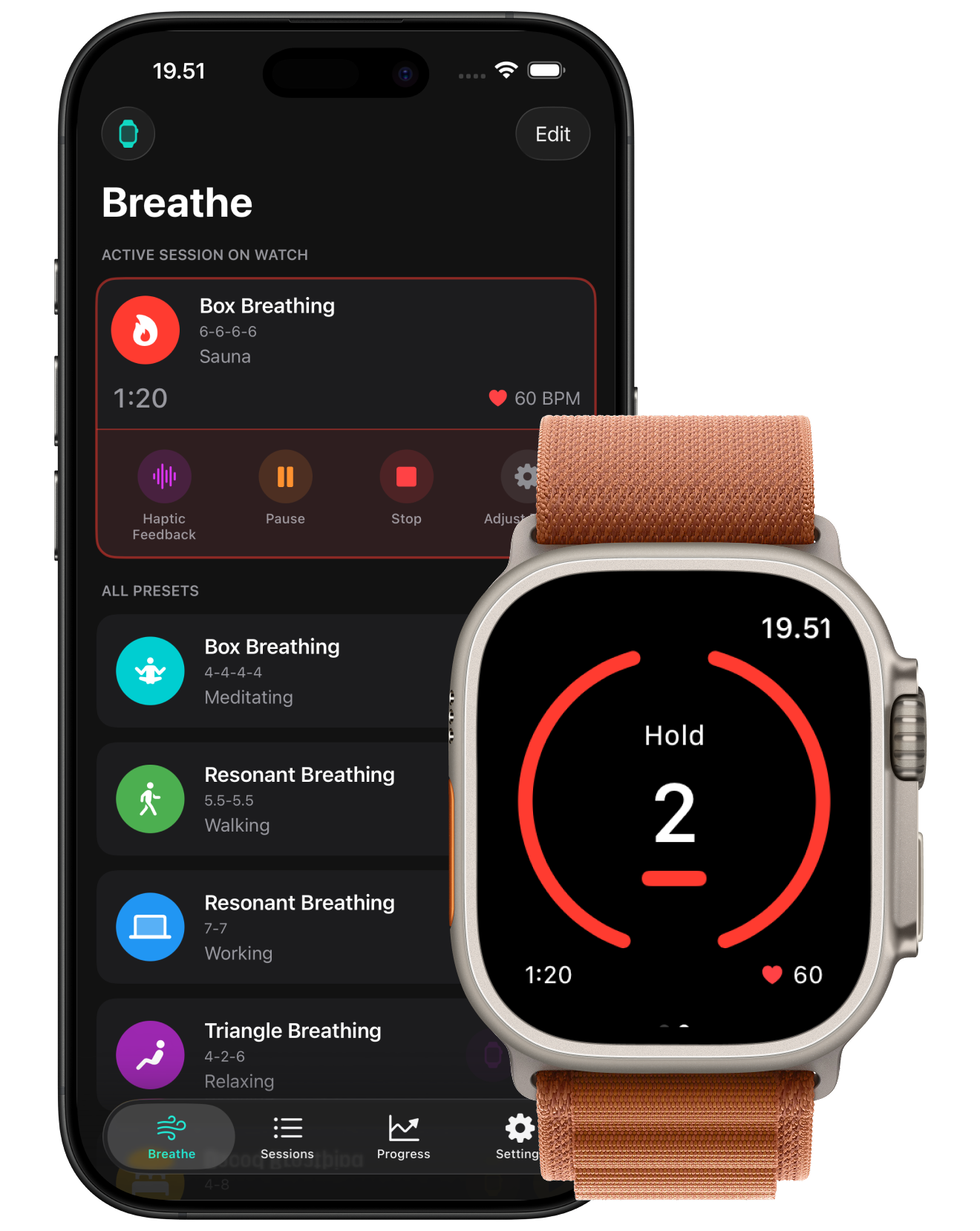
I set the Resonant Breathing default in Pust Focus to 5.5-second inhale, 5.5-second exhale, exactly the timing described in this post. Haptic pulses on your Apple Watch guide each phase, so you can close your eyes or keep walking. It's free to use.
The reason I made the timing adjustable: your personal resonance frequency matters. As we covered above, your individual resonance might be 5.0 or 6.0 seconds per phase instead of 5.5. With premium ($4.99 once, no subscription), you can adjust in 0.5-second steps and save custom presets:
- Starting point (5.5-5.5): The default. The most common resonance frequency and the best place to begin.
- Slightly faster (5.0-5.0): Try this if 5.5 seconds feels strained. 6 breaths per minute is still well within the resonance range.
- Slightly slower (6.0-6.0): For experienced practitioners. 5 breaths per minute, deeper oscillations, more challenging to sustain.
Start with the free default for a week. If the rhythm feels natural and you notice a clear calming effect, you've likely found your frequency. If it feels forced, adjust up or down by half a second and try again.
Sessions run until you stop them, so you can start at 5 minutes and gradually extend to 15-20 as the practice becomes automatic.
Get breathwork done without stopping your day.
References:
- Vaschillo, E., et al. (2006). Resonance in the cardiovascular system. Psychophysiology.
- Lehrer, P.M., & Gevirtz, R. (2014). Heart rate variability biofeedback. Frontiers in Psychology. PMC
- Steffen, P.R., et al. (2017). Impact of Resonance Frequency Breathing on HRV, Blood Pressure, and Mood. Frontiers in Public Health. PMC
- Chaitanya, S., et al. (2022). Effect of Resonance Breathing on Heart Rate Variability and Cognitive Functions in Young Adults. Cureus. PMC
- Bernardi, L., et al. (2001). Effect of rosary prayer and yoga mantras on autonomic cardiovascular rhythms. BMJ. PMC
- Radaelli, A., et al. (2004). Slow breathing reduces chemoreflex response and increases baroreflex sensitivity. Journal of Hypertension. PubMed
- Nestor, J. (2020). Breath: The New Science of a Lost Art. Riverhead Books.
- Porges, S.W. (1994). Polyvagal Theory. Polyvagal Institute
- Laborde, S., et al. (2022). Effects of voluntary slow breathing on heart rate and heart rate variability: A systematic review and a meta-analysis. Neuroscience & Biobehavioral Reviews. PubMed
- Gerritsen, R.J.S., & Band, G.P.H. (2018). Breath of Life. Frontiers in Human Neuroscience. PMC
Try Pust Focus
Breathwork that fits your day, on iPhone and Apple Watch. Free to try, $4.99 once for everything.