Vagus Nerve Stimulation Through Breathing: What the Research Says
The vagus nerve is having a moment. Search "vagus nerve" on social media and you'll find ice baths, ear massage, cold showers, gargling, humming, and dozens of other hacks promising to "activate" it. Some work. Most are overhyped.
But there's one method with decades of peer-reviewed research behind it, and you already do it 20,000 times a day.
Breathing.
What Is the Vagus Nerve?
The vagus nerve (cranial nerve X) is the longest nerve in your body. It runs from your brainstem down through your neck, chest, and abdomen, connecting your brain to your heart, lungs, gut, and other organs.
It's the main pathway of the parasympathetic nervous system, the branch responsible for "rest and digest" functions: lowering heart rate, reducing blood pressure, promoting digestion, and calming inflammation.
The name comes from the Latin word for "wandering," because it wanders throughout the body, touching nearly every major organ system.
Vagal Tone
Vagal tone refers to the activity level of the vagus nerve. Higher vagal tone means your parasympathetic nervous system is more active and responsive.
Higher vagal tone is associated with:
- Better emotional regulation
- Faster recovery from stress
- Lower resting heart rate
- Lower inflammation (via the cholinergic anti-inflammatory pathway)
- Better digestion
- Improved immune function
- Greater social engagement
Lower vagal tone is associated with:
- Chronic stress and anxiety
- Poor recovery from physical or emotional stress
- Higher inflammation
- Digestive issues
- Cardiovascular risk
Stephen Porges' Polyvagal Theory (1994) formalized the relationship between vagal tone and psychological states. His work showed that the vagus nerve isn't just a passive conduit. It actively shapes how we perceive safety and threat, and it can be trained.
How We Measure Vagal Tone
You can't directly measure vagus nerve activity without invasive procedures. But there's a reliable proxy: heart rate variability (HRV).
Specifically, the RMSSD metric (root mean square of successive differences between heartbeats) reflects beat-to-beat variation driven by vagal input to the heart. Higher RMSSD = higher vagal tone.
This is what your Apple Watch, Whoop, or Oura Ring measures when it reports HRV.
How Breathing Stimulates the Vagus Nerve
Every breath you take directly interacts with the vagus nerve through multiple pathways.
Pathway 1: Respiratory Sinus Arrhythmia
When you inhale, your heart rate slightly increases. When you exhale, it decreases. This natural fluctuation is called respiratory sinus arrhythmia (RSA).
The exhale phase is when the vagus nerve is most active. It releases acetylcholine at the sinoatrial node of the heart, slowing the heartbeat. The longer and slower your exhale, the more vagal stimulation you get per breath.
This is why extended exhale breathing (like a 3-second inhale, 6-second exhale) is the most directly calming breathing pattern. You're literally spending more time in the vagal activation phase.
Pathway 2: Lung Stretch Receptors
Your lungs contain stretch receptors that fire when the lungs inflate. These receptors send signals through the vagus nerve to the brain via the Hering-Breuer reflex. Slow, deep breaths activate these receptors more strongly than shallow, fast breaths.
Pathway 3: Baroreceptor Stimulation
Slow breathing creates larger fluctuations in intrathoracic pressure, which affects blood pressure oscillations. Baroreceptors in the aortic arch and carotid sinus detect these changes and signal through the vagus nerve to regulate heart rate. At breathing rates around 6 breaths per minute, this baroreceptor stimulation reaches maximum amplitude.
Pathway 4: Diaphragmatic Pressure
Deep, diaphragmatic breathing physically moves the diaphragm through a larger range. The vagus nerve passes through the diaphragm, and the mechanical pressure of diaphragmatic movement directly stimulates vagal fibers.
What the Research Shows
The Largest Meta-Analysis
A 2022 systematic review and meta-analysis examined 223 studies on voluntary slow breathing and HRV. This is the most comprehensive analysis ever conducted on this topic.
The finding: slow breathing increases vagally-mediated HRV (specifically RMSSD) at all three time points:
- During the breathing session
- Immediately after a single session
- After multi-session interventions (weeks of practice)
The conclusion: "Voluntary slow breathing leads to an increase in parasympathetic nervous control of the heart."
The 2023 Confirmation
A second meta-analysis (2023, Mindfulness) synthesized 31 studies with 1,133 participants and confirmed the same result: slow-paced breathing produces a moderate effect size increase in both RMSSD and SDNN.
Specific Breathing Rates
Not all slow breathing is equal. Research points to an optimal range:
-
Gerritsen & Band (2018), Frontiers in Human Neuroscience: Reviewed the mechanisms of slow breathing and concluded that breathing rates around 6 breaths per minute (0.1 Hz) produce the strongest vagal stimulation.
-
Zaccaro et al. (2018), Frontiers in Human Neuroscience: Systematic review of 15 studies confirmed that slow breathing at ~6 bpm consistently increases parasympathetic activity.
-
Steffen et al. (2017), Frontiers in Public Health: Breathing at resonance frequency (~6 bpm) produced significantly higher HRV and better mood than breathing slightly faster or sitting quietly.
The sweet spot is approximately 5-6 breaths per minute. This aligns with the cardiovascular resonance frequency where heart rate, blood pressure, and breathing oscillations synchronize.
Extended Exhale vs. Equal Breathing
Does the exhale need to be longer than the inhale?
- Laborde et al. (2022), Psychophysiology: A longer exhalation-to-inhalation ratio specifically enhances cardiac vagal activity.
- Komori (2018), Mental Illness: Prolonged exhale (6s out, 4s in) produced significant parasympathetic activation. Equal breathing also works, but extended exhale is stronger.
- Arch & Craske (2006), Behaviour Research and Therapy: A low inhale-to-exhale ratio (28:72) increased pleasant feelings. Equal ratio produced moderate improvement. High inhale ratio produced no decrease in negative feelings.
Bottom line: Equal-phase breathing at 5.5 bpm improves vagal tone. Extended exhale improves it more. Both work. Choose based on context: equal for focus, extended exhale for calming.
The Best Breathing Techniques for Vagal Tone
Based on the research, here are the techniques ranked by vagal stimulation strength:
| Technique | Vagal Activation | Best For |
|---|---|---|
| Extended exhale (3-6) | Very strong | Anxiety, sleep, acute stress |
| Resonant breathing (5.5-5.5) | Strong | Daily HRV training, meditation |
| Box breathing (4-4-4-4) | Moderate | Focus, performance, balance |
| Post-exhale hold (4-4-4) | Strong | Deep relaxation, stillness |
| Fast/shallow breathing | Suppresses vagal tone | Avoid for calming purposes |
What About Other "Vagus Nerve Hacks"?
How does breathing compare to popular vagus nerve stimulation methods?
| Method | Evidence Level | Practicality |
|---|---|---|
| Slow breathing | Very strong (223+ studies) | Do anywhere, anytime, free |
| Cold exposure (face/neck) | Moderate | Uncomfortable, limited settings |
| Singing/humming/chanting | Moderate | Social limitations |
| Gargling | Weak (theoretical) | Minimal evidence |
| Ear massage | Emerging (transcutaneous VNS) | Requires device or technique |
| Meditation | Moderate-strong | Requires training, time |
Breathing is the most practical and best-supported method. It works anywhere, takes 5 minutes, requires no equipment, and has the deepest evidence base.
A Simple Vagal Toning Protocol
Daily practice (5-15 minutes):
- Sit comfortably or lie down
- Breathe in through your nose for 4 seconds
- Breathe out through your nose or mouth for 6-8 seconds
- No forced effort. Smooth, gentle, continuous.
- Repeat for 5-15 minutes
That's a 1:1.5 or 1:2 inhale-to-exhale ratio at roughly 5 breaths per minute. Maximum vagal stimulation in the simplest possible format.
For acute stress (30-60 seconds):
- One long, slow exhale (as long as comfortable)
- Gentle inhale
- Another long exhale
- Repeat 3-5 times
Even a single extended exhale measurably reduces heart rate via the vagal brake mechanism.
How I Set Up Vagal Training in Pust Focus
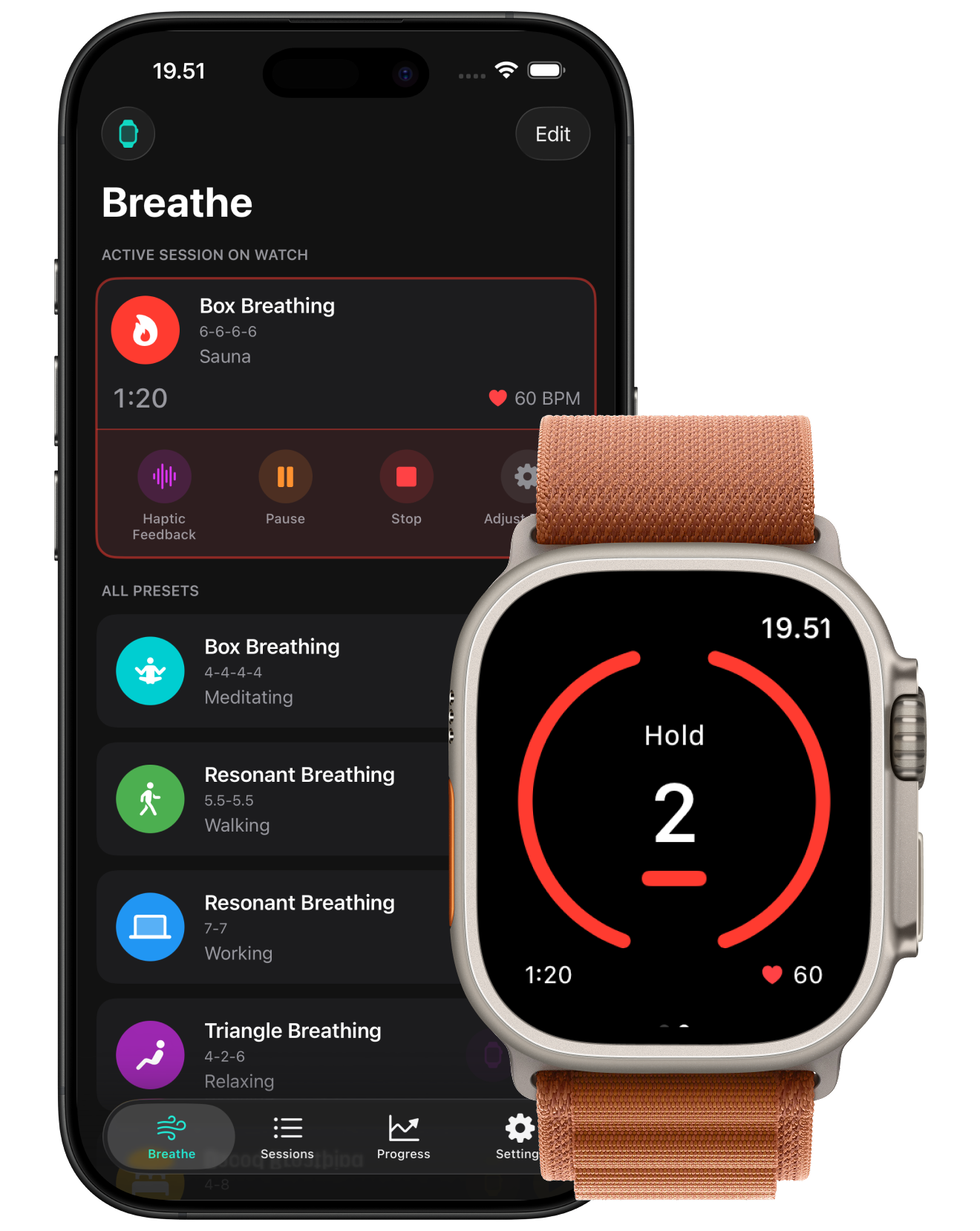
These protocols work best when you can close your eyes and focus on the rhythm without watching a screen. That's why I built Pust Focus. Haptic pulses on your Apple Watch guide each breath while you go about your day. You feel the rhythm instead of watching it.
Here's how I'd set it up based on the research above:
Daily Vagal Training (Free)
Use Resonant Breathing at the default 5.5-5.5. That's 5.45 breaths per minute, right in the optimal range for cardiovascular resonance. Aim for 10-15 minutes. This is your baseline for building vagal tone over time.
Stronger Vagal Activation (Premium)
Switch to Paced Breathing for extended exhale work. I set the default to 3-6, which gives you a 1:2 inhale-to-exhale ratio at ~6.7 breaths per minute. That longer exhale maximizes time in the vagal activation phase of each breath.
For an even slower pace, create a Paced Breathing preset with 4-second inhale and 8-second exhale. That drops you to 5 breaths per minute with a strong extended exhale.
Acute Stress Reset
When you need to calm down fast, open Paced Breathing and breathe along for 60 seconds. Even a few long exhales measurably engage the vagal brake. You can start a session from your Watch or remotely from your iPhone.
Tracking Progress
Sessions are saved to Apple Health with heart rate data, so you can track your resting HRV (RMSSD) trending upward over weeks, a direct indicator of improving vagal tone.
Resonant Breathing and Box Breathing are free. Paced Breathing and custom presets require Premium ($4.99 once, no subscription).
References:
- Meta-analysis: Effects of voluntary slow breathing on HR and HRV. (2022). Neuroscience & Biobehavioral Reviews. PubMed
- Meta-analysis: Slow-Paced Breathing on Cardiovascular and Emotion Functions. (2023). Mindfulness. Springer
- Gerritsen, R.J.S., & Band, G.P.H. (2018). Breath of Life. Frontiers in Human Neuroscience. PMC
- Zaccaro, A., et al. (2018). How Breath-Control Can Change Your Life. Frontiers in Human Neuroscience. PMC
- Steffen, P.R., et al. (2017). Resonance Frequency Breathing. Frontiers in Public Health. PMC
- Komori, T. (2018). Prolonged expiratory breathing. Mental Illness. PMC
- Laborde, S., et al. (2022). Exhale:inhale ratio and cardiac vagal activity. Psychophysiology.
- Porges, S.W. (1994). Polyvagal Theory. Polyvagal Institute
Try Pust Focus
Breathwork that fits your day, on iPhone and Apple Watch. Free to try, $4.99 once for everything.