I Built a Breathing App. Here's How I Actually Use It Every Day.
I practice breathwork during walks and in the sauna. Every breathing app I tried wanted me to stare at a screen. So I built one that uses haptic pulses on my Apple Watch instead.
My name is Michael. I'm a product designer from Aalborg, Denmark. "Pust" means "breathe" in Danish. Pust Focus is my first app.
This isn't a pitch. It's an honest walkthrough of how I use the thing I built, every day, and why it works for me.
Why I Started
I wasn't in crisis. No panic attacks, no insomnia emergency. I just wanted to be sharper.
I'd read the research on slow breathing and HRV. The evidence is solid: breathing at around 5-6 breaths per minute improves heart rate variability, activates the vagus nerve, and trains your nervous system to recover from stress faster. Not "feel-good wellness" claims. Peer-reviewed, replicated findings.
So I started practicing. Resonant breathing during walks. Box breathing in the sauna. The problem was the tools. Every app assumed I was sitting still, looking at my phone. Expanding circles, guided audio, screen animations. That's fine at a desk. It's useless when you're walking through a park or lying in a sauna with your eyes closed.
My Apple Watch was already on my wrist. It could tap me. That's all I needed. A tap to inhale, a tap to exhale. No screen required.
I couldn't find an app that did this well. So I built one.
My Walking Practice
I live next to a forest and take a lot of walks in nature. Most of these walks now double as breathing practice.
The setup: Resonant breathing. Equal inhale and exhale, no holds. I adjust the timing depending on my pace: 6 seconds per phase when I'm strolling, 5 seconds when I'm walking faster. Both land in the optimal range for cardiovascular resonance (roughly 5-6 breaths per minute).
Haptics: Medium intensity, metronome off. The taps are firm enough to feel through a jacket sleeve, but subtle enough that they blend into the walk. Nobody around me knows I'm doing anything. I just feel a gentle pulse on my wrist, and I breathe.
For slow, deliberate walks where I want to focus on nature and the breath itself, I drop the haptics to Low. The taps become almost subliminal. You don't react to them consciously. You just notice your breathing has settled into a rhythm. It's the closest thing to a flow state I've found in a daily practice.
What it feels like: After about 3 minutes, I stop thinking about the breathing. The taps guide me automatically. My mind quiets down. By 10 minutes, I'm in a steady, calm-but-alert state. Not drowsy, not zoned out. Just present.
I don't look at the Watch. I don't count. I just walk and breathe.
My Sauna Practice
This is where the app earns its keep.
I go to the sauna regularly. Usually 2-4 rounds of heat, 15-20 minutes each. One of those rounds is dedicated box breathing for 20 minutes.
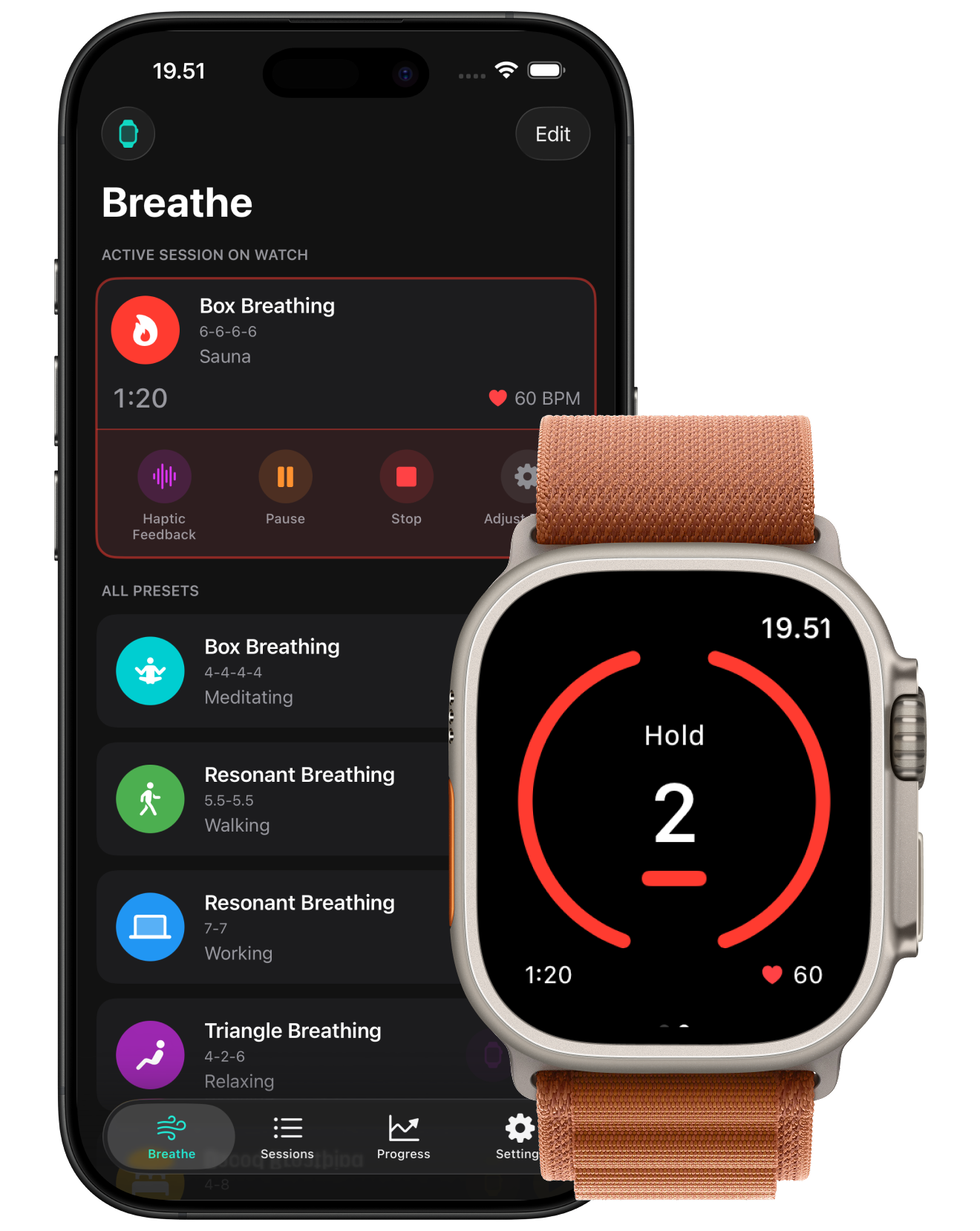
The setup: 6-6-6-6 box breathing. That's 6 seconds inhale, 6 seconds hold, 6 seconds exhale, 6 seconds hold. Slower than the standard 4-4-4-4, which I find too fast for a 20-minute session. The 6-second phases create deeper holds, more CO2 tolerance work, and a rhythm that I can sustain without it feeling like effort.
Haptics: Medium intensity for the main phase transitions (the taps that say "now inhale" or "now hold"). Metronome on, set to Low intensity. The metronome gives a subtle tick each second during every phase. It's like having a quiet clock in the background. Not loud enough to be distracting, but present enough that my mind doesn't wander.
Why the metronome matters: Without it, I drift. A 6-second breath hold is long enough that my mind starts wandering by second 3 or 4. The soft metronome ticks keep a background count going. I don't actively count "1, 2, 3, 4, 5, 6." I just feel the ticks and know where I am in the phase. If my attention wanders, the next tick gently pulls it back.
The experience: The sauna I go to most is Isbjørnen in Aalborg, right on the Limfjord. I lie down, close my eyes or look out across the water. My phone is in a locker. The Watch runs standalone. For 20 minutes, the only input is the rhythm of taps on my wrist. Inhale, hold, exhale, hold. The heat does its thing. The breathing does its thing. I come out feeling like I've reset something fundamental.
The 20-Minute Rule
I set a daily goal of 20 minutes of breathing practice. The app has a daily goal timer that I set to 20:00.
Most days, I hit 20 minutes without trying. A single walk with resonant breathing or one sauna session gets me there. On days where I don't walk much or skip the sauna, I see the timer still counting and I either sit down for a dedicated session or just run one while watching TV in the evening.
The timer isn't magic. It's accountability.
Here's what I've learned about habits: the hardest part is showing up. The breathing itself is easy once you start. Nobody has ever thought "I regret doing that breathing session." But deciding to start one, especially on a busy or tired day, takes friction-reducing help.
The daily goal timer reduces that friction. It's a promise I made to myself, made visible. When I look at my progress view and see weeks of consistent practice, it's proof that I kept the promise. That proof makes it easier to keep it again tomorrow.
The tracking doesn't make the breathing better. It makes showing up easier. And showing up consistently is the entire game.
What I've Noticed After a Few Months
I started being consistent about 2-3 months ago. Here's what changed:
Focus improved. My deep work sessions got longer. I notice fewer impulses to check my phone or email during focused blocks. This could be placebo, but it also aligns with what the research predicts: higher vagal tone improves cognitive control and reduces impulsive behavior.
Sleep got better. I fall asleep faster, especially on days with a sauna session. The combination of heat exposure and 20 minutes of slow breathing seems to thoroughly downregulate the nervous system. On those days, I'm out within 10 minutes of lights off. One thing I've learned: finish the sauna at least 90 minutes before bed. Your body needs time to cool down, and if you go too late, the elevated temperature actually keeps you up.
HRV is trending up. My Oura Ring HRV data shows a measurable improvement over the past few months. Day-to-day HRV fluctuates a lot (alcohol, poor sleep, and stress all tank it), but the weekly trend line is climbing. This is the most objective signal that something real is happening.
Calmer baseline. This is the hardest one to quantify but the most noticeable. Stressful things still happen. Deadlines, unexpected problems, frustrating situations. They just land differently now. There's a slightly longer pause between the stimulus and my reaction. I don't think the breathing practice "fixed" anything. I think it trained my nervous system to recover faster.
My Exact Setup
If you want to try what I do, here are my presets:
Walking Preset:
- Technique: Resonant Breathing
- Timing: 5.5s inhale, 5.5s exhale (or 6-6 for slower walks)
- Activity: Walking
- Haptic intensity: Medium
- Metronome: Off
Sauna Preset:
- Technique: Box Breathing
- Timing: 6-6-6-6
- Activity: Relaxing
- Haptic intensity: Medium
- Metronome: On, intensity Low
Daily Goal: 20 minutes
For walks, I usually start sessions from my iPhone using remote start. During Danish winters, my Watch is buried under gloves and a jacket, so pulling out my phone, tapping a preset, and putting it back in my pocket is much easier. The session runs on the Watch from there. For the sauna, my phone stays in the locker. The Watch handles everything standalone.
What Pust Focus Is (and Isn't)
It's a breathing timer with haptic guidance on iPhone and Apple Watch. Five techniques. Custom timing. Presets. Sessions saved to Apple Health with heart rate data. You can practice on either device. I find it works best on the Watch since the haptics are on your wrist and the session continues even when the screen dims, but the iPhone app is a full practice tool too.
It's not a meditation app. No voice guides, no ambient sounds, no content library, no weekly drops. You configure your practice once and use it.
It's free to try with two techniques (Box and Resonant). The full unlock with all five techniques and custom presets is $4.99, once. No subscription.
I built it because I needed it. I use it every day because it works.
Try Pust Focus
Breathwork that fits your day, on iPhone and Apple Watch. Free to try, $4.99 once for everything.