Cyclic Sighing: The 5-Minute Breath That Beat Meditation in a Stanford Trial
One breathing pattern outperformed mindfulness meditation on mood and respiratory rate in a month-long Stanford controlled trial. It takes five minutes a day. You already do it, involuntarily, when you sigh.
The technique is called cyclic sighing, and in the two and a half years since the original study published, a second controlled trial has extended its reach from "feeling better" into acute clinical pain.
Here is what the research actually shows, and how to practice it.
What Is Cyclic Sighing?
Cyclic sighing is built on the physiological sigh, a two-part inhale followed by a long, slow exhale. Your body does this spontaneously when you are stressed, sleeping, or recovering from crying. The double inhale reinflates collapsed alveoli in your lungs. The extended exhale dumps CO₂ and shifts your nervous system toward the parasympathetic side.
The deliberate version is simple:
- Inhale through the nose.
- Inhale again through the nose, shorter and on top of the first. Fill the lungs.
- Exhale slowly through the mouth until the lungs are empty.
- Repeat.
The exhale should be noticeably longer than the combined inhales. No breath holds, no counting rituals, no special cadence. Just double in, long out.
The Stanford 2023 Study
The headline research is Balban et al., published in Cell Reports Medicine in January 2023 out of Stanford's psychiatry and neurobiology departments (senior authors David Spiegel and Andrew Huberman).
Design: remote, randomized, controlled. 108 healthy adults, 28 days, five minutes of practice per day. Four groups:
- Cyclic sighing
- Box breathing (equal inhale, hold, exhale, hold)
- Cyclic hyperventilation with retention
- Mindfulness meditation (control)
Mood was tracked daily with the PANAS (Positive and Negative Affect Schedule) before and after each session. Respiratory rate, heart rate, and HRV were captured via WHOOP strap.
Results:
- All three breathwork groups improved mood more than meditation. Averaged across breathwork, the daily positive-affect increase was 1.91 points on PANAS, versus 1.22 points for meditation.
- Cyclic sighing showed the largest effect of the four conditions, with a statistically significant advantage over meditation on positive affect (p < 0.05).
- Breathwork groups reduced resting respiratory rate more than meditation over the month.
- The benefit was cumulative: the more consecutive days participants practiced, the bigger the mood gain per session.
That last point matters. This is not a one-off trick for a panic moment. The trial was measuring what happens when you do this every day for a month.
The 2025 Follow-Up: Cyclic Sighing in a Clinic Waiting Room
Hanley, Davis, Worts, et al. published a pilot RCT in the Journal of Behavioral Medicine in February 2025 (Florida State University, IRB STUDY00004696).
They took cyclic sighing out of the lab and into the X-ray waiting room of a walk-in orthopedic clinic. Patients did 4 minutes of asynchronous, self-guided cyclic sighing while waiting for imaging. The control group got a time-matched injury-management briefing of the same length.
Results:
- Patients in the cyclic sighing group reported significantly lower pain intensity while waiting.
- They also reported significantly lower pain unpleasantness, which is the affective component of pain (how much it bothers you), separate from the raw sensation.
- Anxiety and depression scores did not differ between groups. The effect was on pain specifically, not on general mood in an acute-care setting.
This is a small pilot (single site, healthy enough to walk into a clinic), but it is the first controlled evidence that a brief, patient-directed breathing exercise can move the needle on clinical pain in a real medical setting.
Why the Long Exhale Matters
The common thread between the two trials is the extended exhale.
When you exhale slowly, the vagus nerve tells your heart to slow down between beats. That slowing shows up as higher heart rate variability, which is one of the cleanest physiological markers of parasympathetic (rest-and-digest) tone. A 2025 review in Acta Neurologica Belgica synthesized six slow-breathing trials and reported that the patterns emphasizing prolonged exhalation drove the largest gains in high-frequency HRV and baroreflex sensitivity.
The two-part inhale has its own role (reinflating alveoli, maximizing CO₂ gradient for the exhale), but the exhale is doing most of the nervous-system work.
This is also why cyclic sighing feels different from cyclic hyperventilation (Wim Hof style). Same trial, both "breathwork," opposite physiology. Hyperventilation pushes CO₂ out fast and ramps sympathetic tone up. Cyclic sighing pushes CO₂ out slowly and pulls sympathetic tone down.
How to Practice It
Five minutes. That is the full protocol from the Stanford study.
- Sit comfortably. Eyes open or closed, either works.
- Start a five-minute timer.
- Inhale through the nose, then inhale again through the nose to top off.
- Exhale slowly through the mouth until the lungs feel empty.
- Repeat at whatever pace feels natural. Most people land somewhere around 4 to 6 cycles per minute.
- When the timer ends, stop.
The best times to try it:
- Between two mentally taxing tasks, as a reset.
- In the 10 minutes before bed, to drop resting heart rate.
- Before a difficult conversation, when you can feel the stress response starting.
- In a waiting room, per the 2025 trial.
What We Still Do Not Know
Worth stating plainly:
- Both trials were short. The Stanford study ran 28 days; the clinic study was a single 4-minute session.
- Both samples were small by clinical-trial standards (108 and pilot-scale).
- Mood outcomes rely on self-report scales. Physiological outcomes used a consumer wearable.
- Nobody has yet compared cyclic sighing head-to-head against 4-7-8 breathing or resonance breathing in a single trial.
What the evidence does support is modest but real: five minutes a day of cyclic sighing, done consistently, appears to lift daily mood and lower resting respiratory rate more than an equivalent dose of mindfulness meditation, and a short session appears to take the edge off acute pain in a clinical waiting-room setting.
If you are going to try one breathwork pattern for a week and see what shifts, this is a defensible place to start.
References
-
Balban MY, Neri E, Kogon MM, Weed L, Nourber B, Jo B, Holl G, Zeitzer JM, Spiegel D, Huberman AD. "Brief structured respiration practices enhance mood and reduce physiological arousal." Cell Reports Medicine. 2023 Jan 17;4(1):100895. doi:10.1016/j.xcrm.2022.100895
-
Hanley AW, Davis A, Worts P, et al. "Cyclic sighing in the clinic waiting room may decrease pain: results from a pilot randomized controlled trial." Journal of Behavioral Medicine. 2025. doi:10.1007/s10865-024-00548-5
-
"Breathe better, live better: the science of slow breathing and heart rate variability." Acta Neurologica Belgica. 2025. doi:10.1007/s13760-025-02789-w
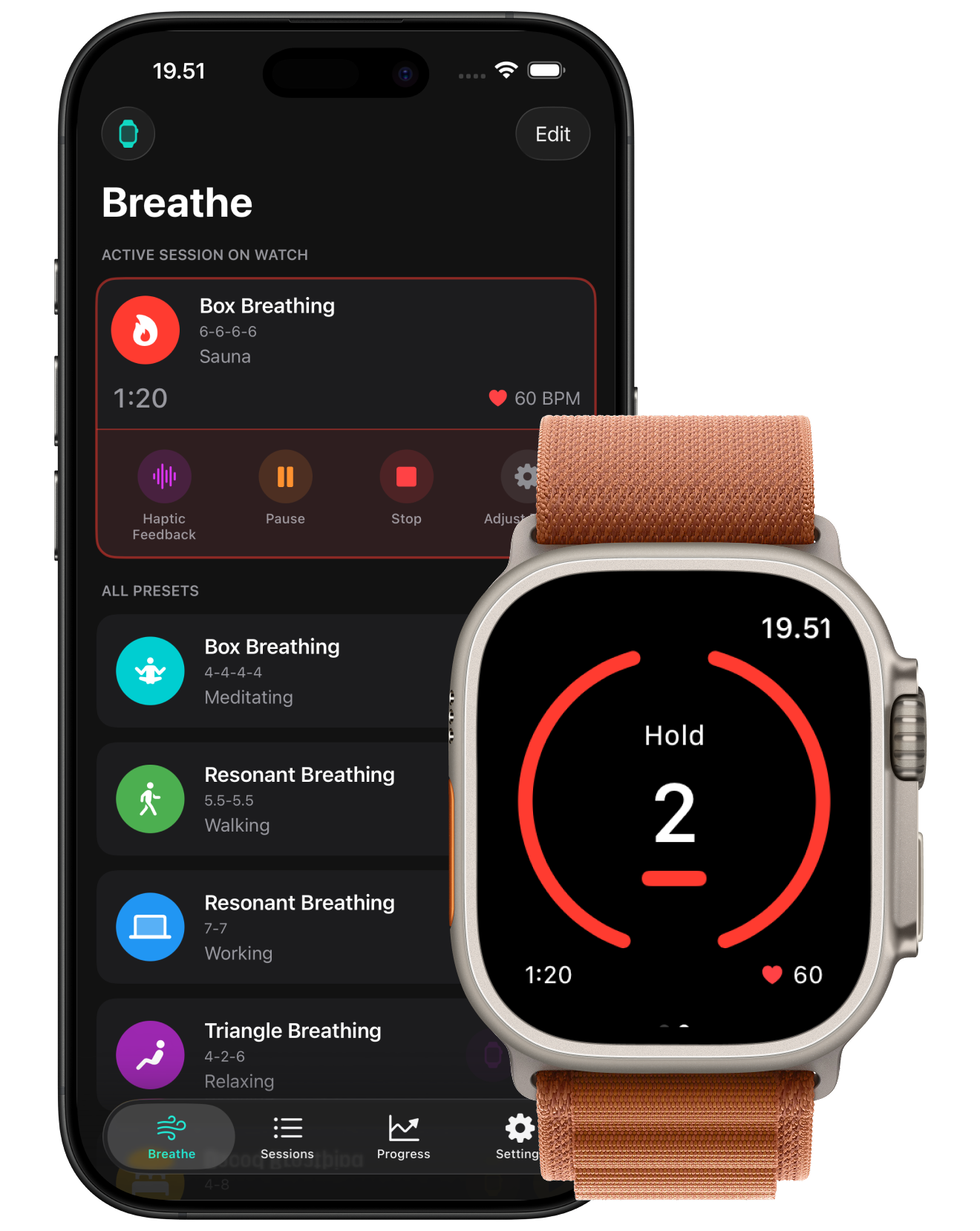
Try Pust Focus
Breathwork that fits your day, on iPhone and Apple Watch. Free to try, $4.99 once for everything.