Box Breathing vs 4-7-8: Which Technique Is Right for You?
You've probably heard of both box breathing and 4-7-8 breathing. They're two of the most popular breathing techniques out there, and for good reason: both are backed by real science, both take less than five minutes, and both can shift your nervous system from "fight or flight" to "rest and digest."
But they're not interchangeable. One is built for focus. The other is built for sleep. Pick the wrong one at the wrong time, and you'll either feel drowsy before a presentation or wired before bed.
Here's the breakdown.
What Is Box Breathing?
Box breathing follows a symmetrical four-phase cycle:
- Inhale for 4 seconds
- Hold (lungs full) for 4 seconds
- Exhale for 4 seconds
- Hold (lungs empty) for 4 seconds
The name comes from the equal-length sides, like a square. Each cycle takes 16 seconds, which works out to about 3.75 breaths per minute.
Box breathing was popularized by Mark Divine, a retired U.S. Navy SEAL Commander, who learned it during SEAL training and later built it into the SEALFIT performance program. It's now standard training for military, law enforcement, and first responders.
What Is 4-7-8 Breathing?
The 4-7-8 technique follows an asymmetrical three-phase cycle:
- Inhale through the nose for 4 seconds
- Hold for 7 seconds
- Exhale through the mouth for 8 seconds
This technique was developed by Dr. Andrew Weil, a Harvard-trained integrative medicine physician, in the 1990s. He based it on pranayama, an ancient yogic breathing practice, and has called it "a natural tranquilizer for the nervous system."
The key design principle is the 2:1 exhale-to-inhale ratio: 8 seconds out versus 4 seconds in.
The Science Behind Each
Box Breathing Research
A landmark 2023 study from Stanford (Balban et al., Cell Reports Medicine) compared box breathing, cyclic sighing, cyclic hyperventilation, and mindfulness meditation across 108 participants over 28 days. All breathwork methods improved mood and reduced physiological arousal more effectively than meditation alone. Box breathing significantly reduced respiratory rate and improved self-reported calmness.
A systematic review of 15 studies (Zaccaro et al., 2018, Frontiers in Human Neuroscience) found that slow breathing at roughly 6 breaths per minute consistently increases parasympathetic activity, improves emotional control, and enhances psychological well-being. Box breathing at 4-4-4-4 is even slower at 3.75 breaths per minute, well within the "slow breathing" territory where these benefits occur.
A meta-analysis of 12 randomized controlled trials (Fincham et al., 2022, Scientific Reports) showed that breathwork reduced stress with a significant effect size (g = -0.35).
4-7-8 Breathing Research
A 2022 study (Vierra et al., Physiological Reports) specifically tested the 4-7-8 technique in healthy volunteers and found it significantly reduced heart rate and blood pressure after a single session compared to controls.
Research on extended-exhalation breathing (Magnon et al., 2021, Scientific Reports) showed that patterns emphasizing longer exhales, like 4-7-8, significantly increased high-frequency HRV, a direct marker of parasympathetic activation.
A comprehensive review (Gerritsen & Band, 2018, Frontiers in Human Neuroscience) confirmed that extended exhalation activates the vagus nerve more strongly than equal-phase breathing, because exhalation is the phase during which the parasympathetic nervous system naturally dominates the cardiac cycle.
Why They Work Differently
The difference comes down to exhale-to-inhale ratio.
Box breathing uses a 1:1 ratio. The symmetrical pattern means roughly equal time in the sympathetic phase (inhale + hold) and parasympathetic phase (exhale + hold). The result: a regulated but alert state.
4-7-8 uses a 2:1 ratio. With 15 of 19 seconds spent in hold or exhale (both parasympathetic phases), it pushes the nervous system strongly toward rest. The result: deep relaxation, often drowsiness.
During exhalation, the diaphragm relaxes upward, reducing pressure in the chest. This activates stretch receptors in the lungs (the Hering-Breuer reflex), which signal through the vagus nerve to slow the heart rate. A longer exhale means more time in this parasympathetic-dominant phase.
The breath holds matter too. Box breathing's two holds (after inhale and after exhale) build CO2 tolerance and train respiratory control. The 4-7-8's single long hold (7 seconds) allows more complete gas exchange and builds CO2 at a rate that has a mild sedative effect.
When to Use Which
| Situation | Use This | Why |
|---|---|---|
| Can't fall asleep | 4-7-8 | Extended exhale is deeply sedating |
| Pre-presentation nerves | Box | Calms without inducing drowsiness |
| Acute panic or anxiety | 4-7-8 | Stronger parasympathetic activation |
| Need focus before a task | Box | Symmetrical pattern maintains alertness |
| Midday stress reset | Box | Returns to baseline without over-sedating |
| Chronic insomnia routine | 4-7-8 | Dr. Weil reports increasing efficacy over weeks |
| During a stressful event | Box | Simpler to execute under cognitive load |
| Post-conflict cool down | 4-7-8 | More powerful sympathetic deactivation |
The short version: Box for performance, 4-7-8 for recovery.
Side-by-Side Comparison
| Feature | Box Breathing | 4-7-8 Breathing |
|---|---|---|
| Pattern | 4-4-4-4 | 4-7-8 |
| Cycle length | 16 seconds | 19 seconds |
| Breaths per minute | ~3.75 | ~3.16 |
| Number of holds | 2 | 1 |
| Exhale:inhale ratio | 1:1 | 2:1 |
| Energy effect | Calming but alert | Deeply sedating |
| Learning curve | Easy (equal intervals) | Moderate (7s hold is challenging) |
| Best time of day | Anytime | Evening/bedtime |
Can You Do Both?
Yes. They serve complementary purposes and work well as a daily pair:
- Morning/daytime: Box breathing for focus and stress management
- Evening/bedtime: 4-7-8 for winding down and sleep
Some practitioners do 2-3 rounds of box breathing to stabilize, then transition to 4-7-8 to deepen relaxation. Using different breathing protocols at different times of day is generally more effective than relying on a single technique for everything.
Tips for Getting Started
Box breathing:
- Start with 4-4-4-4 (the standard)
- 4-6 cycles is enough for most situations (about 1-2 minutes)
- Breathe through the nose
- You can do this with your eyes open, at your desk, in a meeting
4-7-8 breathing:
- Start with 4 cycles maximum (Dr. Weil's recommendation for beginners)
- If 7 seconds feels too long, shorten proportionally (e.g., 2-3.5-4) while keeping the ratio
- Always practice sitting or lying down initially (the long hold can cause lightheadedness)
- Exhale through the mouth with a "whoosh" sound
- Build up to 8 cycles over several weeks
Important note: Neither technique should replace professional treatment for clinical anxiety, insomnia, or PTSD. Both are generally safe for healthy adults, but the breath holds can be challenging if you have respiratory conditions like COPD or severe asthma.
Beyond 4-4-4-4: Finding Your Box Breathing Duration
Most guides teach box breathing as a fixed 4-4-4-4 pattern. But 4 seconds per phase is just the starting point. Mark Divine, the Navy SEAL Commander who popularized the technique, explicitly recommends progressing to longer durations: "Start with 5 seconds... but you can work up second by second. Try 6 seconds, then 7 and 8."
The standard 4-second duration was chosen for military training because it is accessible under extreme stress and easy to count during high-pressure situations. For daily practice in calmer conditions, longer phases offer different benefits.
How Duration Changes the Experience
| Pattern | Cycle Length | Breaths/Min | Feel |
|---|---|---|---|
| 4-4-4-4 | 16 seconds | 3.75 | Focused and alert. Comfortable for beginners. The standard. |
| 5-5-5-5 | 20 seconds | 3.0 | Noticeably slower. Deeper calm, moderate CO2 challenge. |
| 6-6-6-6 | 24 seconds | 2.5 | Deep and meditative. Requires practice to stay comfortable. |
| 7-7-7-7 | 28 seconds | 2.14 | Advanced. Strong CO2 tolerance training. Not for beginners. |
What the Science Says
No published study has directly compared these durations head-to-head. But related research tells us what to expect:
CO2 tolerance is the key variable. During each breath hold, carbon dioxide builds in your bloodstream. Longer holds mean more CO2 accumulation, which trains your body's chemoreceptors to tolerate higher levels without triggering the "I need to breathe" panic response. This is why longer box breathing feels progressively easier over weeks of practice (Van Diest et al., 2019).
Longer holds increase cerebral blood flow. Rising CO2 during holds triggers the Bohr Effect: hemoglobin releases oxygen more readily to tissues, and blood vessels in the brain dilate. This combination of better oxygen delivery and increased blood flow may explain the mental clarity that experienced practitioners report during longer box breathing sessions (Nivethitha et al., 2017).
There is a ceiling. Research on yogic breath retention (Saoji et al., 2019) suggests that holds exceeding 7 seconds begin recruiting a more significant stress response. For most people, 5-6 seconds per phase is the sweet spot between challenge and comfort.
HRV responds differently. A 2025 study (Marchant et al.) found that simple 6-breaths-per-minute breathing (no holds) produced higher HRV than standard 4-4-4-4 box breathing. This makes sense: box breathing is optimized for focus and CO2 tolerance, not HRV. If your primary goal is HRV improvement, resonant breathing (5.5 seconds in, 5.5 seconds out, no holds) is more effective. Resonant breathing is also free in Pust Focus.
How to Progress
Andrew Huberman recommends calibrating your box breathing duration to your CO2 tolerance. A simple test: take 4 normal breaths, inhale fully, then exhale as slowly as possible. Time your exhale.
| Your Slow Exhale | Start With |
|---|---|
| Under 25 seconds | 3-4 seconds per phase |
| 25-45 seconds | 5-6 seconds per phase |
| Over 50 seconds | 7-8 seconds per phase |
Progress by adding 0.5-1 second per phase every week or two. There is no rush. The benefit comes from consistent practice at a duration that is challenging but not stressful.
The Breathing Ratio Framework
Once you understand the exhale-to-inhale ratio, you can predict the effect of any breathing technique:
- 2:1 inhale-dominant (e.g., Wim Hof): Activating, energizing
- 1:1 balanced (e.g., box breathing): Calming but alert
- 1:2 exhale-dominant (e.g., 4-7-8): Deep relaxation, sedation
This gives you a mental model for understanding all breathing techniques, not just these two.
Try Both in Pust Focus
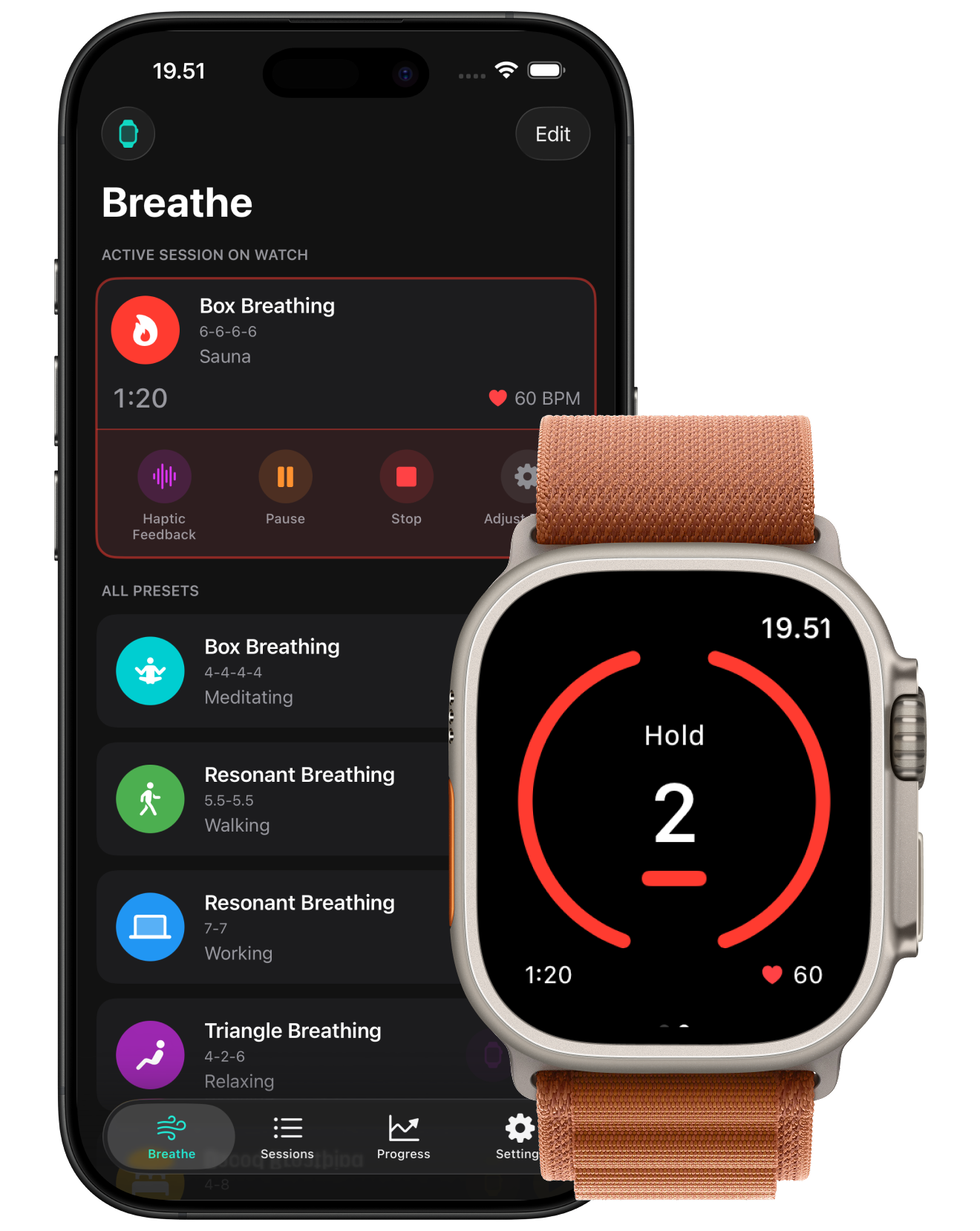
I built Pust Focus so you can get breathwork done during your day, not on top of it. Haptic pulses on your Apple Watch guide each phase, so you practice while walking, working, or winding down. No screen needed.
Box breathing at the default 4-4-4-4 is free. With premium ($4.99 once, no subscription), you can adjust the phase duration from 1 to 30 seconds in 0.5-second steps and save custom presets. Here's how I'd set it up for different situations:
- Quick reset (4-4-4-4): The default. I use this for a 2-minute stress break at my desk.
- Deep focus (5-5-5-5): A slower rhythm for longer sessions. 20-second cycles, 3 breaths per minute.
- Sauna or meditation (6-6-6-6): 24-second cycles for when you want to go deep. I pair this with the metronome on Low to keep count without thinking.
References:
- Balban, M.Y., et al. (2023). Brief structured respiration practices enhance mood and reduce physiological arousal. Cell Reports Medicine. PMC
- Zaccaro, A., et al. (2018). How Breath-Control Can Change Your Life. Frontiers in Human Neuroscience. PMC
- Fincham, G.W., et al. (2022). Effect of breathwork on stress and mental health. Scientific Reports. Link
- Vierra, J., et al. (2022). Effects of 4-7-8 breathing on heart rate variability and blood pressure. Physiological Reports. PMC
- Magnon, V., et al. (2021). Extended-exhalation breathing and cardiac vagal activity. Scientific Reports.
- Gerritsen, R.J.S., & Band, G.P.H. (2018). Breath of Life. Frontiers in Human Neuroscience. PMC
- Ma, X., et al. (2017). Diaphragmatic breathing, attention, and stress. Frontiers in Psychology.
- Marchant, J., et al. (2025). Comparing the Effects of Square, 4-7-8, and 6 Breaths-per-Minute Breathing on HRV, CO2, and Mood. Applied Psychophysiology and Biofeedback. PubMed
- Van Diest, I., et al. (2019). Training of paced breathing at 0.1 Hz improves CO2 homeostasis. PLOS ONE. PMC
- Nivethitha, L., et al. (2017). Cerebrovascular hemodynamics during pranayama techniques. Journal of Neurosciences in Rural Practice. PMC
- Saoji, A.A., et al. (2019). Effects of yogic breath regulation. Journal of Ayurveda and Integrative Medicine. PMC
Try Pust Focus
Breathwork that fits your day, on iPhone and Apple Watch. Free to try, $4.99 once for everything.