Best Breathing Apps for Apple Watch in 2026
Your Apple Watch is strapped to your wrist all day. It tracks your heart rate, detects irregular rhythms, and monitors blood oxygen. But most people never use it for the one thing it's perfectly positioned to do: guide your breathing.
Haptic taps on your wrist. No screen needed. You can practice breathwork during a walk, in a meeting, in the sauna, or lying in bed with your eyes closed.
The problem is choosing the right app. There are dozens on the App Store, and they're not all trying to do the same thing. The best app for falling asleep is different from the best app for managing stress, which is different from the best app for training your HRV.
So this guide is organized by what you're trying to achieve. Find your goal, understand which breathing technique serves it, and pick from the top apps for that category.
The Apps
Here's every app covered in this guide, with links and pricing at a glance.
| App | Price | Link |
|---|---|---|
| Apple Mindfulness | Free (built-in) | Apple Support |
| Breathing Zone | Free | App Store |
| Unwind | Free / $14.99 lifetime | App Store |
| iBreathe | Free / $3.99 once | App Store |
| Calm | Free / ~$70/year | calm.com |
| Breathwrk (Peloton) | Free / $49/year | App Store |
| Oak | Free | App Store |
| Wim Hof Method | Free / $43/year | wimhofmethod.com |
| Pust Focus | Free / $4.99 once | App Store |
Prices checked February 2026. Last updated February 2026. Full disclosure: I built Pust Focus. I've tried to be fair in every category, but you should know my bias going in.
Improve Your HRV
The goal: Raise your heart rate variability, the metric that Oura, Whoop, and Apple Watch use to measure autonomic health and recovery. Higher HRV correlates with better stress resilience, faster recovery, and improved cardiovascular fitness.
The technique: Resonant breathing. Equal inhale and exhale at approximately 5.5 seconds each (5.5 breaths per minute). At this rate, your cardiovascular system enters resonance: heart rate variability peaks, blood pressure oscillations synchronize, and your baroreflex operates at maximum efficiency (Lehrer & Gevirtz, 2014). Research shows 15-20 minute sessions produce the strongest effects (Steffen et al., 2017).
What to look for: Adjustable timing matters here. Your personal resonance frequency falls between 4.5 and 7.0 breaths per minute, and the difference between 5.0 and 5.5 seconds per phase is real. Apps that let you fine-tune in small increments have an edge.
Top picks
Breathing Zone — Includes coherent breathing as one of four techniques. Adjustable breathing rate, sessions up to 60 minutes, Watch haptics. The microphone-based breathing analyzer is a unique feature for checking your actual pace. Free.
iBreathe — Fully customizable timing with 0.5-second resolution. Watch app with heart rate monitoring. You can build a resonant breathing pattern at any rate you want. The interface is busier than others, but the flexibility is there. Free / $3.99 once.
My take
This is the category I care about most, and it's why I built Pust Focus. Resonant Breathing is one of two free techniques. Default is 5.5-5.5, adjustable in 0.5-second steps with premium. What I wanted that I couldn't find elsewhere: haptic guidance on every phase change so I could close my eyes, sessions that save heart rate data to Apple Health, and no time cap so I could do the 15-20 minute sessions the research calls for. Free / $4.99 once.
Manage Stress and Sharpen Focus
The goal: Regain composure during acute stress, or prime your nervous system for concentration. Think: before a difficult conversation, during a chaotic day, or settling into deep work.
The technique: Box breathing. Inhale, hold, exhale, hold, each for equal duration. The classic pattern is 4-4-4-4 (4 seconds per phase). The breath holds create a brief CO2 buildup that sharpens attention, while the structured rhythm prevents spiraling thoughts. Used by Navy SEALs, first responders, and athletes.
What to look for: The app must support 4-phase patterns (inhale-hold-exhale-hold). Many breathing apps only do inhale-exhale, which isn't box breathing.
Top picks
Breathing Zone — Box breathing included as one of four patterns. Watch haptics, adjustable rate, up to 60 minutes. Solid and reliable. Free.
Oak — Box breathing is one of three breathing modes. Clean, minimal interface. Completely free. The tradeoff: no custom timing and minimal Watch support, so you're mostly using it on your phone. Free.
My take
Box Breathing is the other free technique in Pust Focus. Default 4-4-4-4, adjustable timing with premium. I use it before focused work and in the sauna. The haptic taps on both hold phases are what I find most useful, since holds are the hardest part to time without a guide. Custom presets let you save different durations as you progress (5-5-5-5, 6-6-6-6). Free / $4.99 once.
Calm Anxiety and Wind Down
The goal: Shift your nervous system from fight-or-flight to rest-and-digest. Reduce anxiety in the moment, or wind down after a stressful day.
The technique: Extended exhale breathing. Short inhale, long exhale. Common patterns include 3-6 (inhale 3s, exhale 6s) and 4-8. The longer exhale activates the vagus nerve more strongly than equal breathing, producing a measurable parasympathetic shift. The 2023 Stanford study found that exhale-focused "cyclic sighing" outperformed meditation for mood improvement (Balban et al., 2023).
What to look for: The app needs to support asymmetric timing (different durations for inhale vs. exhale). Many apps only do equal-phase breathing, which won't give you the extended exhale effect.
Top picks
iBreathe — Fully customizable patterns with 0.5-second resolution. Pre-designed anxiety and relaxation routines included. You can build any inhale-exhale ratio you want. Watch app with heart rate tracking. Free / $3.99 once.
Unwind — Custom exercise creation with adjustable intervals. Beautiful ambient soundscapes add atmosphere. The heart rate comparison (before vs. after sessions) gives tangible feedback that the practice is working. Free / $14.99 lifetime.
My take
Paced Breathing in Pust Focus defaults to 3-6 (inhale-exhale), and you can adjust the ratio with premium. I use this one before bed or after a rough day. The haptic-only guidance on Watch means no screen light, no sound, just a tap telling me when to switch. Free trial / $4.99 once.
Fall Asleep Faster
The goal: Quiet your mind and body before bed. Transition from the day's stress into sleep-ready mode.
The technique: 4-7-8 breathing or extended exhale. 4-7-8 (inhale 4s, hold 7s, exhale 8s) was popularized by Dr. Andrew Weil as a "natural tranquilizer for the nervous system." The long hold and extended exhale create a strong parasympathetic shift. Extended exhale patterns like 3-6 or 4-8 work similarly but without the hold.
What to look for: The app should support 3-phase patterns (inhale-hold-exhale) with different durations for each phase. Haptic guidance is especially valuable here, since you're lying in bed with your eyes closed and don't want screen light.
Top picks
Breathing Zone — 4-7-8 is a built-in technique with female voice guidance and countdown. No manual setup needed. Watch haptics guide you in the dark. The best out-of-the-box experience for this specific pattern. Free.
iBreathe — Customizable to any 3-phase pattern including 4-7-8. Pre-designed sleep routines built in. Free / $3.99 once.
My take
Triangle Breathing in Pust Focus supports inhale-hold-exhale patterns. You can set it to 4-7-8 timing with premium and save it as a preset. I'll be honest: for 4-7-8 specifically, Breathing Zone has the better out-of-the-box setup since it's a dedicated mode. Pust Focus requires manual configuration, but once you save the preset, it's one tap to start. Free trial / $4.99 once.
Learn Breathwork with Guided Coaching
The goal: You're new to breathwork and want someone to walk you through it. Or you prefer variety and fresh content over repeating the same pattern daily.
The technique: Varies. Guided apps offer instructor-led sessions categorized by goal (calm, focus, energy, sleep), so you don't need to choose a technique yourself.
What to look for: Quality of instruction and library depth. One tradeoff: audio-guided classes work better on your phone or with headphones than through Watch haptics alone. The coaching model and the "haptic only" model are somewhat at odds.
Top picks
Breathwrk (Peloton) — The deepest library: hundreds of guided exercises updated daily, categorized by goal. Breath coaches walk you through each session. Lung score and exhale tests add gamification. The downside: subscription-heavy ($49/year), Watch support is minimal, and you need audio. Free with limits / $49/year.
Calm — Breathing exercises alongside meditation, sleep stories, and music. Beautiful production quality. The Watch app exists but is limited (no account sign-in, needs Bluetooth headphones). Best if you already use Calm for other features and want breathing as an add-on. Free with limits / ~$70/year.
Oak — Three guided breathing modes (Box, Deep Calm, Awake) plus guided meditations. Minimalist and almost entirely free. Less content than Breathwrk or Calm, but no subscription pressure. Free.
Why not Pust Focus here? It has no guided audio, no voice coaching, and no class library. It's a timer-and-haptics tool, not a teaching tool. If you want someone explaining what to do and why, the apps above are better fits.
Get Energized (Activating Breathwork)
The goal: Wake up your body and mind. Boost energy before a workout, cold plunge, or demanding task. This is the opposite of relaxation breathing.
The technique: Controlled hyperventilation followed by breath retention. The Wim Hof Method is the most well-known protocol: 30-40 deep, rapid breaths, then exhale and hold for as long as you can. Repeat for multiple rounds. This deliberately activates the sympathetic nervous system.
Important note: Hyperventilation-based breathing can cause lightheadedness, tingling, and in rare cases fainting. Never practice during driving, swimming, or any situation where losing consciousness is dangerous.
Top pick
Wim Hof Method — The only serious option in this category on Apple Watch. Guided breathing with customizable rounds, Apple Watch support (watchOS 7+), cold exposure tracking, structured courses, and Spotify/Apple Music integration. Strong community and brand. Free with limits / $5.99/month / $42.99/year.
No other Apple Watch app covers activating breathwork at this level. If energy and activation is your goal, the Wim Hof app is the clear answer.
Why not Pust Focus here? All five techniques in Pust Focus are slow-breathing patterns designed to calm your nervous system. It doesn't support rapid breathing, hyperventilation protocols, or round-based retention holds. Different tool for a different job.
Just Start Breathing (Complete Beginners)
The goal: You've never done breathwork. You want to try it with zero learning curve and zero cost. Just a prompt to slow down and breathe.
The technique: Simple slow breathing. No specific ratio, no holds. Just inhale and exhale at a guided pace that's slower than your default.
What to look for: Low friction. It should take zero setup to start a session.
Top picks
Apple Mindfulness — Already on your Watch. One tap to start. Clean animation, gentle haptics. Sessions are 1-5 minutes. It's limited for serious practice, but for "just breathe for a minute," it's perfect. Free.
Oak — "Deep Calm" mode is simple guided breathing with a clean interface. Completely free. Also includes meditation if you want to go further. Free.
Unwind — Beautiful design makes the experience feel premium from the start. Easy to begin. The ambient soundscapes add atmosphere without complexity. Free with limits / $14.99 lifetime.
Why not Pust Focus here? You could use it. Box Breathing and Resonant Breathing are both free, and starting a session is straightforward. But Pust Focus assumes you already know what technique you want. It doesn't teach you what breathwork is or guide you through your first session. For complete beginners, the apps above do a better job of easing you in.
Full Comparison Table
| App | Techniques | Custom Timing | Watch Haptics | Max Session | HealthKit | Price |
|---|---|---|---|---|---|---|
| Apple Mindfulness | 1 | No | Yes | 5 min | Mindful Min | Free |
| Breathing Zone | 4 | Yes | Yes | 60 min | Mindful Min | Free |
| Unwind | Custom | Yes | Yes | Flexible | Yes | Free / $14.99 lifetime |
| iBreathe | Custom | Yes (0.5s) | Yes | Flexible | Mindful Min + HR | Free / $3.99 once |
| Calm | Limited | No | Limited | Varies | Yes | ~$70/year |
| Breathwrk | 100+ guided | No | Minimal | Varies | Yes | $49/year |
| Oak | 3 | No | Minimal | 24 hrs | Mindful Min | Free |
| Wim Hof | 1 (WHM) | Rounds | Yes | Flexible | Yes | $43/year |
| Pust Focus | 5 | Yes (0.5s) | Yes | Unlimited | Mindful Min + HR | Free / $4.99 once |
The Bottom Line
The right app depends on what you're trying to achieve, not which app has the most features.
If you want to improve your HRV, pick an app with resonant breathing at adjustable rates. If you want to fall asleep faster, you need 4-7-8 or extended exhale support. If you want to manage stress in the moment, look for box breathing. If you want a coach walking you through it, go with a class-based app. If you want an energy boost, the Wim Hof app is the only real option.
One thing I'd recommend regardless of category: prioritize Watch haptics. The whole advantage of breathwork on your wrist is that you don't have to watch a screen. If an app makes you stare at an animation on a 45mm display, you might as well use your phone.
Start with Apple's Mindfulness app to build the habit. When you know what you're training for, come back to this guide and pick the app that matches your goal.
References:
- Zaccaro, A., et al. (2018). How Breath-Control Can Change Your Life. Frontiers in Human Neuroscience. PMC
- Lehrer, P.M., & Gevirtz, R. (2014). Heart rate variability biofeedback: How and why does it work? Frontiers in Psychology. PMC
- Steffen, P.R., et al. (2017). The Impact of Resonance Frequency Breathing. Frontiers in Public Health. PMC
- Balban, M.Y., et al. (2023). Brief structured respiration practices enhance mood. Cell Reports Medicine. PMC
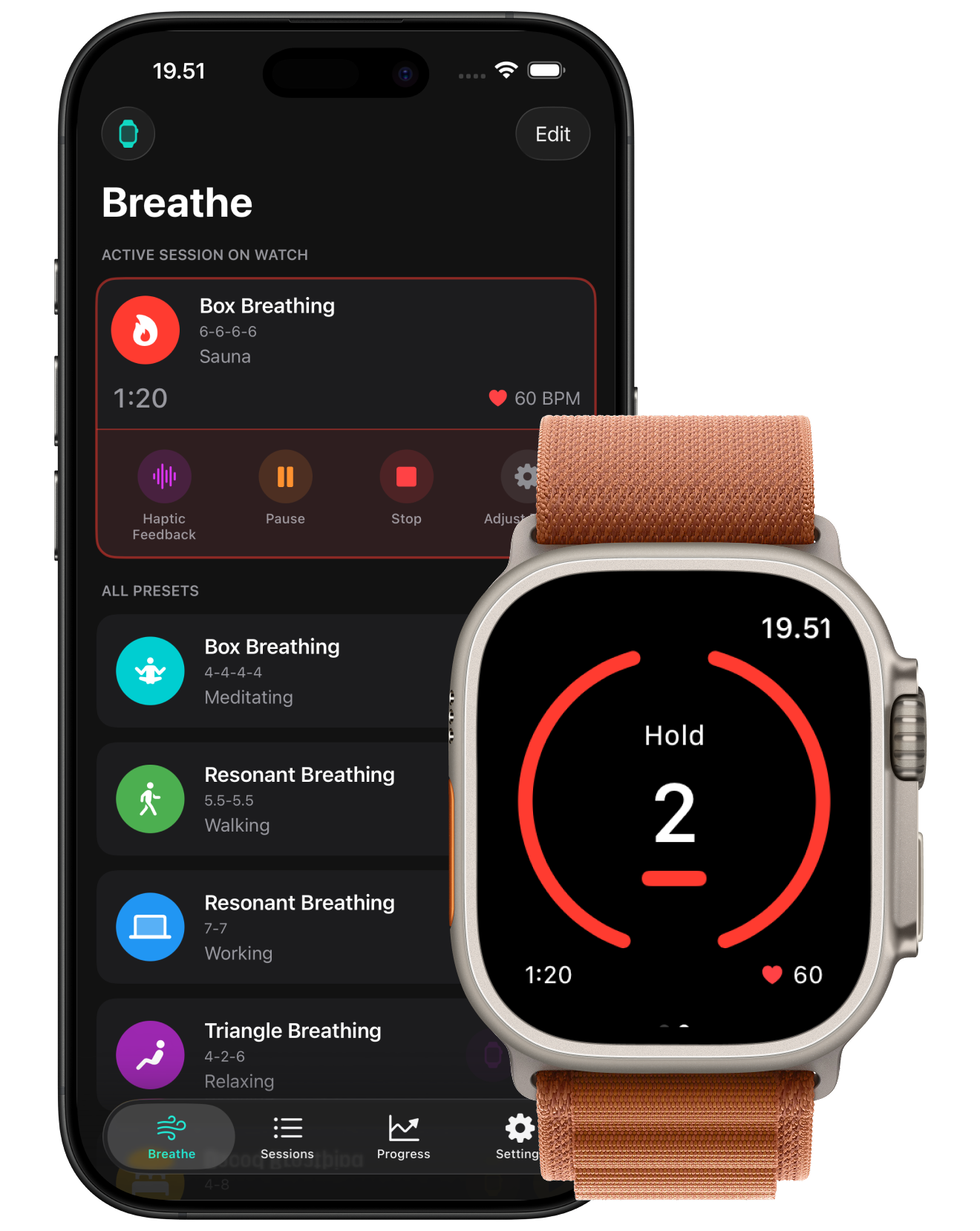
Try Pust Focus
Breathwork that fits your day, on iPhone and Apple Watch. Free to try, $4.99 once for everything.